Seed preparation
Use plump, undamaged seed. Wet, cold soil at or after sowing is the main cause of seed rot and damping-off in cowpeas, so wait for warm soil rather than treating the seed.
 Shop at deodar-seeds.com Free EMS courier delivery across India

Legume growing guide
Yard long bean is a climbing, heat-loving form of cowpea that sprouts in about a week in warm soil and crops for months on a tall trellis. This guide covers sowing depth, warm-soil timing, support and the picking stage that keeps pods tender.
Use plump, undamaged seed. Wet, cold soil at or after sowing is the main cause of seed rot and damping-off in cowpeas, so wait for warm soil rather than treating the seed.
Not needed. None of the extension guides for yard long bean or cowpea call for nicking or abrading the seed; it is sown as it is.
Not needed. It is a tropical warm-season crop with no cold requirement; cold soil harms it.
Not needed. Sow dry seed into soil that is already moist and water once; keeping the seed out of cold, wet conditions matters more than any pre-soak.
Plant when the soil is above 18 °C (65 °F) and all frost risk is past. In laboratory tests on cowpea, germination and seedling vigour peaked at about 30.5-35.5 °C (87-96 °F) depending on variety. At 20 °C (68 °F) seed still germinated well but slowly; at 40 °C (104 °F) it germinated but produced abnormal seedlings.
About 5 cm (2 in) in loose, friable soil and 2.5 cm (1 in) in heavy soil. Grain-cowpea guides give 2-2.5 cm (3/4-1 in); stay at the shallow end in clay or crusting soil.
A well-drained, worked bed. Yard long bean tolerates acid soils and grows at pH 5.5-7.5; Texas extension advises liming only below pH 6.0.
Moist but not soggy. Water after sowing, then avoid saturating the soil until seedlings are up.
Cover the seed; light is not needed for germination. Choose a site in full sun.
About one week in warm soil. In cool soil emergence is slower and losses to rot rise.
Direct sowing is the normal method. Along a row trellis, sow seeds 8-10 cm (3-4 in) apart and later thin to 15-30 cm (6-12 in), with rows 0.9-1.2 m (3-4 ft) apart. On a tripod or pole, sow 3-4 seeds per pole.
Vines reach 2.7-3.7 m (9-12 ft). Put up the trellis before sowing: at least 2 m (7 ft) high, with poles about 2-6 cm (3/4-2.5 in) thick. Guide the first tendrils onto it.
Go easy on nitrogen. Cowpeas fix their own; high nitrogen pushes vine growth and can reduce the pod crop.
Yard long bean thrives in heat and withers in cold. In the Indian plains it suits the warm months and the early monsoon on well-drained beds; in the tropics it is traditionally direct-seeded early in the rainy season.
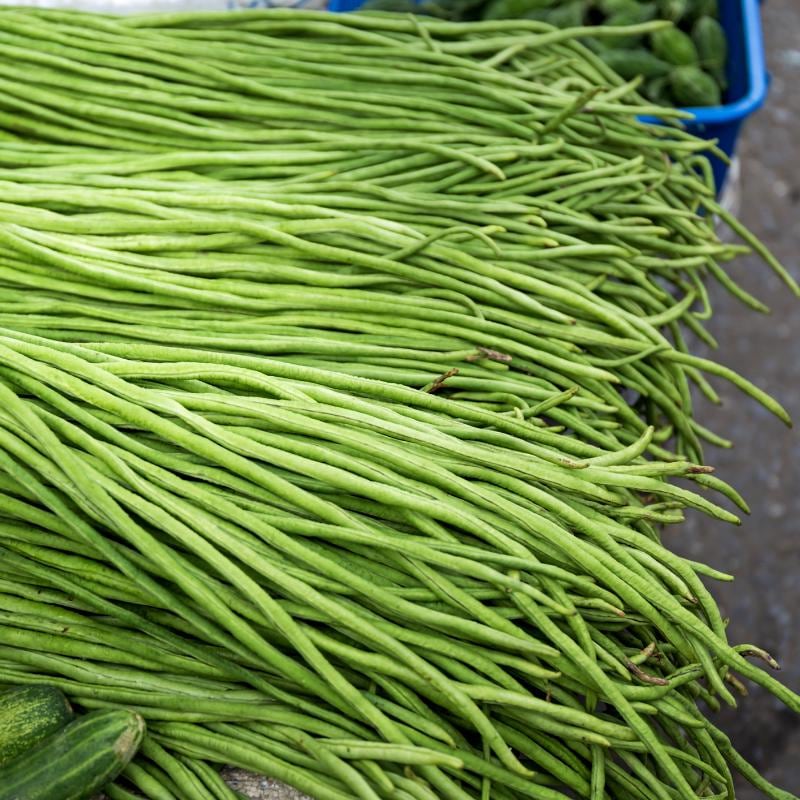
Pods lengthen fast after pollination. Pick while they are still tender, about half the thickness of a pencil and before the seeds bulge. Pods can grow to 90 cm (36 in), but the eating stage is earlier.
Picking usually starts about 2 months after sowing and continues as long as the weather stays warm. Regular picking keeps the vines flowering.
Plants tolerate some drought, but steady moisture during flowering and pod set keeps them producing. Two follow-up sowings 2 weeks apart extend the harvest in long seasons.
Sow yard long beans in warm soil beside a tall trellis for months of tender pods.
No. It is a subspecies of cowpea (Vigna unguiculata), not the common bean Phaseolus vulgaris. It needs more heat, climbs much higher and has thinner, longer pods.
The usual reason is cold or waterlogged soil, which makes the seed rot. Sow when the soil is above 18 °C (65 °F), 2.5-5 cm (1-2 in) deep, and keep it moist rather than wet.
While the pods are still slender and snap easily, before the seeds swell. Older pods turn fibrous even though they keep getting longer.