 Shop at deodar-seeds.com
About this seed
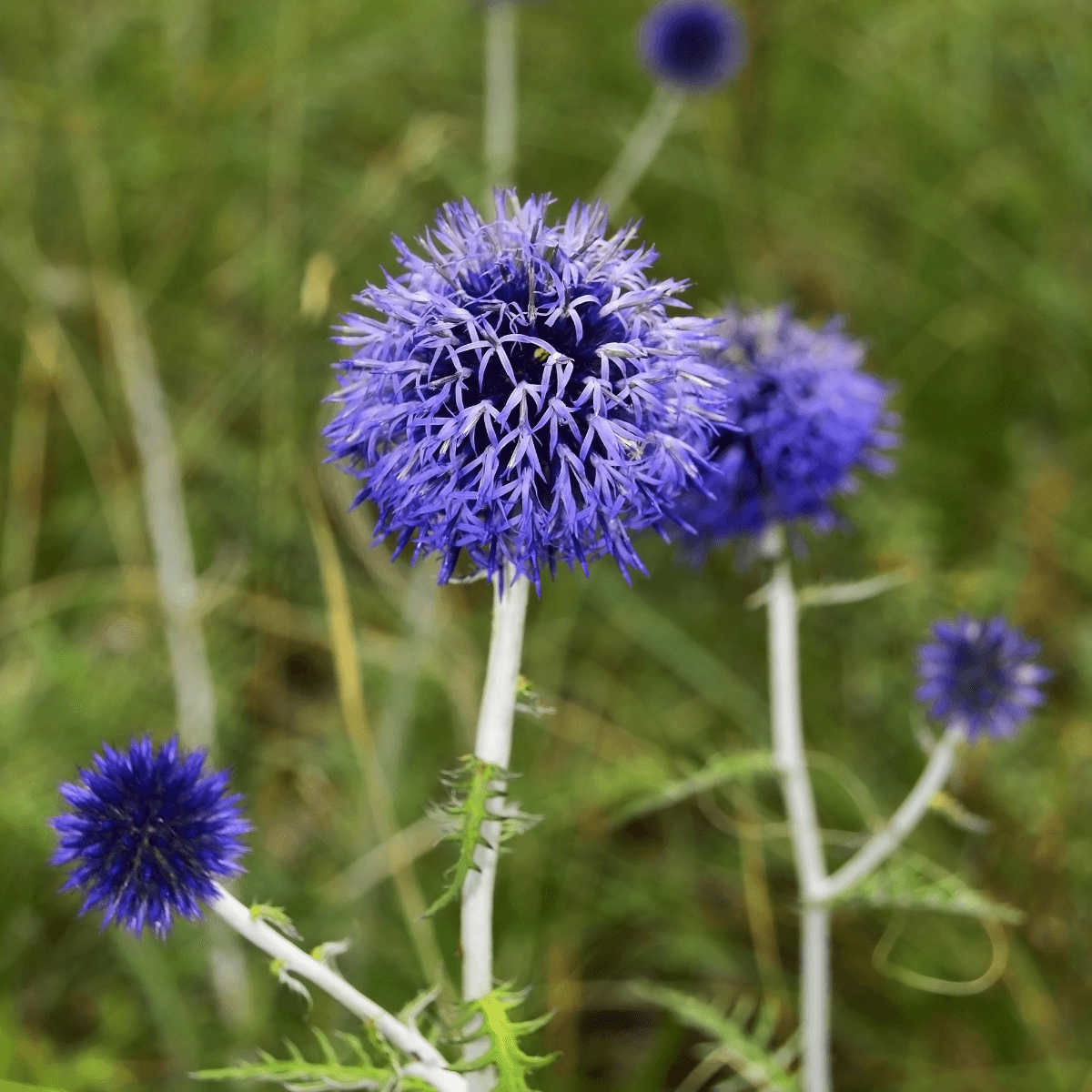
Great globe thistle (Echinops sphaerocephalus) is a perennial of the daisy family (Asteraceae) that carries near-perfect spheres of flowers, up to 6 cm across, on stems typically 50–100 cm tall.
Also known as: Great globe thistle, Glandular globe thistle, Pale globe thistle, Drüsenblättrige Kugeldistel (German), Échinops à tête ronde (French), Mordovnik sharogolovy.
What the plant becomes
- Flower heads are white or blue-gray and open from June to September.
- Leaves are large, soft, toothed and lobed; the upper side is sticky and hairy, the underside white and woolly.
- Bees, wasps and butterflies are the usual visitors.
- Wild plants grow in sunny, rocky or brushy places.
Sowing and growing
- Press the seed onto the surface of moist mix and cover it only very lightly (about 1.5 mm); light helps germination.
- Keep it at about 21–24 °C. One supplier guide gives 10–14 days to emerge; we have no tested emergence time for this lot.
- Thin or transplant to 30–38 cm apart in full to partial sun.
- Once established the plant tolerates dry spells.
Choosing a spot
Give it sun and open, well-drained ground, closer to its rocky wild habitat than to a wet border. Leave room for tall, upright stems rather than planting it in a small pot.
FAQ
Is globe thistle an annual?
No. It is a perennial herbaceous plant that returns from the same root each year.
Do the seeds need light?
Surface sowing is advised, because light helps germination. Do not bury the seed deeply.
Which insects visit the flowers?
Mainly bees, wasps and butterflies.